Employee community building features: What’s new in OfficeSpace
By Sahara Muradi• 15 mins read•October 4, 2026
A 2026 JLL report, Global Occupancy Planning Benchmark Report 2026, found that offices run at 56% utilization against a 74% target. That gap is as much a coordination problem as a real estate one. Nobody can tell who else is coming on that day. Your people show up hoping to catch a teammate, find half the floor empty, and stop bothering.
Employee community building features put that answer in front of people. They sit inside your workplace experience software and give your team simple ways to plan the day and find each other. They also help you welcome guests and stay connected once everyone arrives. Here are the community-building features in OfficeSpace Software and what each one adds to the employee experience.
Why employee community building features matter now
Connection at work is no longer a soft metric. A 2026 Gallup report, State of the Global Workplace: 2026 Report, found that global employee engagement fell to 20% in 2025. The last comparable low came in 2020. Gallup puts the cost at roughly $10 trillion in lost productivity, or 9% of global GDP.
Ten trillion dollars is a global number, and it will never show on your own dashboard. The mechanism behind it will. Disengaged people come in less. Anyone who does come in gets less from the trip.
Read that number as a workplace problem as much as an HR one. A facilities lead and a people team will each read it differently. You cannot fix engagement with a floorplan, but you can remove the small daily frictions that make the office feel pointless. Those frictions are specific, and most of them come down to not knowing who is around.
When people don’t feel connected to those around them, engagement drops. So does the return on every square foot you manage. A conference room nobody uses and a desk nobody books trace back to the same root cause. Employees don’t see a reason to come in.
Employee community building features address that root cause directly. They replace the survey and the policy memo with a change to the building itself. Navigating the existing office gets easier. Coming in becomes worth the trip.
Follow the evidence on attendance
The office is not disappearing. A 2026 Gensler study, the 2026 Global Workplace Survey, authored by Janet Pogue McLaurin, surveyed more than 16,400 office workers. Employees spend 55% of their typical workweek in the office. Those same employees want to spend even more time there when the office supports it.
The pattern holds across the industry. JLL’s 2026 benchmark found that 62% of companies now require a fixed number of in-office days. A year earlier, it was 49%. Fully remote work has fallen to 10%.
What actually brings people in is narrower than most mandates assume. A 2026 CBRE report, Global Workplace and Occupancy Insights, Part 4, quantified it. In that research, 93% of respondents cite collaboration with colleagues as an important reason to be in the office.
The same research found something sharper. Employees are far more likely to come in when most of their colleagues are present. Attendance follows people, but calendars and policy statements can lag.
Read those two findings together and the conclusion gets uncomfortable for policy-led returns. People come in for each other. If they can’t tell who else is coming, the policy carries the whole load. The policy is your weakest tool.
Employee community building features answer that question. They replace a guess with a fact, every morning, before anyone decides whether the trip is worth it.
Put a cost number beside the culture case
A cost argument sits underneath the culture one. Every desk you lease is a fixed expense against a headcount that varies by the day. The 18-point gap JLL reports between target and actual utilization is where that money sits, and closing part of it changes your next lease conversation.
A 2026 Steelcase report, New Research: 5 Ways Your Office Will Change by 2027, authored by Areli Arellano, surveyed nearly 500 United States decision-makers. Most now plan for desk-sharing ratios of 2:1 or higher. Shared desks only work when people can see who is coming in.
Neither argument works on its own. A finance case with no reason for people to show up produces a mandate nobody likes. Culture cases with no number attached rarely survive a budget review.
Meet your OfficeSpace AI agents
The AI Agent is available across the platform to help you locate colleagues, rooms, printers, and more. Search for resources using a colleague’s name or a conference room name. Start your message to the Agent with a keyword such as “locate,” “find,” and “where,” or use a natural language query. The Agent guides you to the specific location in your office on the floorplan.
With the OfficeSpace MCP, employees can also use their existing AI tools, including Claude and ChatGPT, to book desks. They describe their booking needs in their own words, OfficeSpace checks the request against available seating, maintains booking rules, and completes the reservation. This all happens without the employee leaving the chat with the LLM.
Of the employee community building features in this release, this is the one your team will touch most. Three groups feel it first.
- Everyone stops losing the first five minutes of every office day hunting for a person or a room.
- New hires settle in faster, since the Agent answers the questions they would otherwise take to a coworker.
- Facilities teams field fewer “where is” messages, because your employees can answer the question themselves.
Those three gains arrive together from one feature. The larger your office, the more each one compounds.
Automate desk booking with the Workplace Experience Agent
The Workplace Experience (WEX) Agent, part of AI Canvas, uses context from your workplace to make more informed recommendations and remove steps from the employee workflow.
Instead of hunting for a desk that meets their needs, employees see a list of recommendations, including desks they’ve booked in the past, near their favorite coworkers, or close to an upcoming meeting. If an employee hasn’t yet booked a desk, the WEX Agent prompts them when they arrive at the office, with these recommendations built in.
Additionally, the WEX Agent recommends days to come into the office based on team schedules and historical booking data. Teams show up on the same days of the week, improving collaboration on site and driving attendance.
Scale the agents across a bigger footprint
OfficeSpace AI agents don’t just enable employees to move faster, they also make the workplace more self-serve.
Your team may already use employee wayfinding tools, which allows them to locate and navigate to resources from an interactive floor plan. The AI Agent and Workplace Experience Agent simplify the process further. Employees can ask the agents questions in plain language to find spaces, resources, and colleagues, without clicking through the platform.
As headcount and sites increase, so does wayfinding complexity. Unlike a static directory, these community-building features scale with your footprint. Hybrid teams can easily coordinate days and on-site work, even within larger teams and spaces. Employees visiting a new office location can query the same platform they always use, and new hires can find their way around without figuring out who to ask.
This level of speed and autonomy also means there’s less of a burden on workplace and facilities teams to coordinate staff or answer navigational questions.
Protect focused work as interaction rises
One caution is worth stating plainly. More in-office interaction is not automatically better. A 2026 Harvard Business Review article, The Office Amenity That Actually Improves Teamwork, authored by Ron Friedman, drew on a study of more than 6,000 knowledge workers. Friedman found that the strongest teams are defined less by office perks than by their ability to protect focused work.
The OfficeSpace AI agents and all of the community-building features are built on that logic. Employees don’t need to tap someone on the shoulder every time they need to find something. Instead, they can get the answers themselves in seconds.
Book desks for visitors
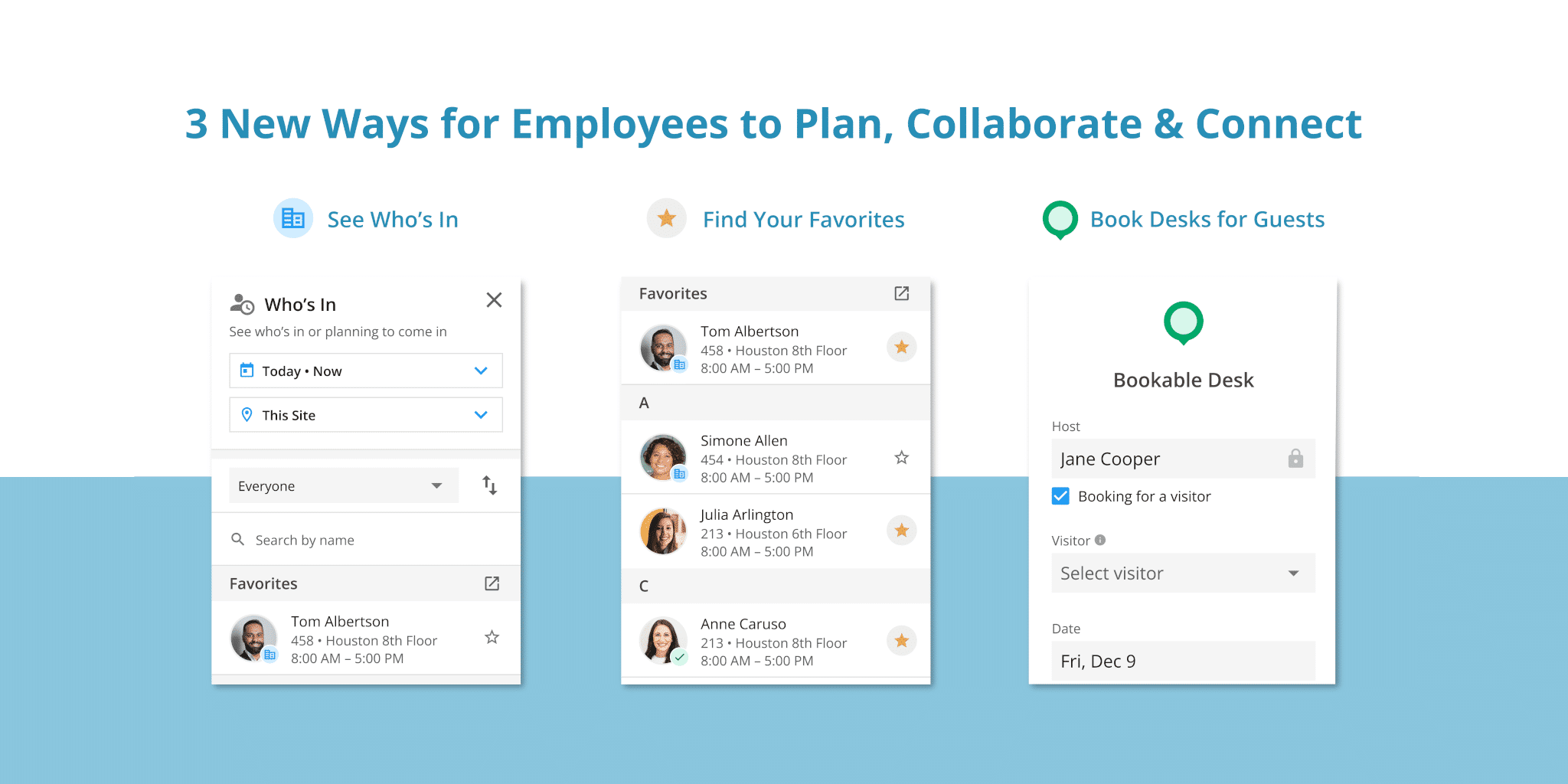
You can now book desks on behalf of visitors. This includes guests for single-day bookings on-demand, or booked-ahead visitors when hosting multi-day meetings and events.
Employees use the familiar desk booking flow in Visual Directory® to select the location. They then simply indicate they are booking on behalf of a visitor. Anyone who can book their own desk can already book one for a guest. To use visitor desk booking, you need the visitor management module active on a particular site.
OfficeSpace Visitors allows you to customize your visitor workflows, sign-up steps, notifications, and wayfinding kiosks. That keeps visitor arrivals smooth from the moment a guest walks in across locations. Arrivals also leave a record. A complete visitor log, plus occupancy insights for visitors, complements Visitor Desk Booking, giving admins a clear read on visitor trends across sites.
Here’s why this matters: Most community-building features impact your own teams. Visitor desk booking impacts guests, including clients.
Visitors judge your company by what happens when they arrive. A guest with a reserved desk and a clear plan feels expected and welcome. One who wanders the floor looking for somewhere to sit does not. That first impression is hard to undo.
Like the other employee community building features here, this removes a manual step. Email and spreadsheets used to handle this job. The booking now lands in the same record as every other desk. Booking a visitor’s desk inside the same flow keeps the experience consistent, for staff and guests alike.
The space numbers gain from this too. Visitor demand now lands in the same utilization picture as employee demand. Your numbers reflect everyone who actually used the floor, payroll and guests alike.
See who’s in the office
Today you can see who is planning to come into the office with assigned or booked desks. Visual Directory® and the Employee Homepage also show who has actually arrived. That makes it easier to connect in person with coworkers. When an employee is present, a building icon will appear beside their profile in 3 locations.
That distinction has a budget attached. Scheduling a cafe, a cleaning rota, or a front desk against reservations means staffing based on guesswork. Staffing against presence means staffing against the building as it actually fills.
Feed presence from systems you already run
Presence is the engine under the other employee community building features. Data arrives through presence feeds, including access control systems, WiFi feeds, or CSV uploads.
When an employee swipes their badge or connects to the WiFi, the presence icon displays. Coworkers then see that their teammates have arrived. Admins configure this for visibility at the account level or the user level. Presence indicators can be hidden for privacy.
Read the three numbers in Who’s In
Who’s In also highlights three numbers. You see how many employees are expected today, how many have checked in, and how many are already in the office. That gives you a fast read on key metrics.
You get an honest sense of how busy the office will be, without pulling a separate report. Those three numbers sit on a screen your team already has open. They answer the question most people would ask someone anyway.
Why does this matter? Because a booked desk is a statement of intent and nothing more. Plans change, trains run late, and meetings move. Presence data tells you what is happening right now, and it is the one number that changes a staffing call.
A 2026 Owl Labs report, the tenth annual State of Hybrid Work Report, surveyed 2,000 full-time knowledge workers in the United States. The study found that office friendships matter to 69% of employees. Employee community building features clearly answer “who’s actually here today,” removing a barrier to those relationships. Planning around colleague attendance makes time at the office more valuable.
Favorite coworkers
The Who’s In list already names everyone planning to come into the office. Employees can now also favorite specific coworkers on their team, in their department, or anyone else they plan to see during their workday. Favorites is the simplest of the employee community building features to explain and the quickest to adopt.
In the Who’s In list, employees can simply click on the star icon beside the names of coworkers they wish to see in favorites. These favorites appear at the top of their Who’s In list.
They stay at the top of the list so you know immediately when specific coworkers are planning to come in or are already in the office.
Knowing who will be in the room changes how people plan their week. See where your favorite coworkers are sitting before booking a desk. Check which days are the best to come into the office. You can add up to 30 coworkers to your favorites list in Who’s In.
Favorites also pay off in space planning. When enough people star each other, you can see which teams cluster and which never overlap. Those patterns make a better input to a neighborhood plan than a reporting line on an org chart.
A new employee three weeks into the job doesn’t yet know which days their manager or mentor usually comes in. Favorites give them that answer at once. Nobody has to send an awkward message asking for someone’s schedule.
That small bit of visibility helps a new hire feel like part of the team. Chance encounters do that faster than a generic onboarding checklist ever could.
Roll out employee community building features across every site
Big teams rarely manage a single office. Every feature in this release is built with that in mind. Presence visibility, favorites, and visitor desk booking are all set up per site. A facilities lead running 50 sites can standardize the rollout, while each office still reflects its own layout.
The AI agents work the same way. Your floorplan and directory feed it, site by site. A new hire in your Chicago office gets accurate answers about that building. They do not get a generic response built for headquarters.
Start with the site where your badge data is most accurate and the local lead is ready to champion the rollout. That first building becomes your benchmark for every other location, so give it your best setup. A reliable first launch builds the trust the rest of your sites depend on, which makes the right order more valuable than the fastest one.
Admins keep a single point of control over these employee community building features throughout. Three decisions stay yours.
- Which sites turn on presence first. You pick the order, building by building.
- How the settings apply. Visibility runs by account or by individual, as you choose.
- When visitor desk booking joins a site. Each location switches on at your discretion.
These features only work if your employees trust the data behind them. A presence icon that is accurate in one building and unreliable in another erodes that trust fast. Consistency is what keeps people checking who’s in every morning.
Presence, favorites, and the AI agents each give employees a reason to open OfficeSpace every day, and every visit makes your data more complete. Presence adds who actually arrives. Favorites show which coworkers people plan their days around. The AI agents give employees a fast way to find spaces and colleagues, which keeps them coming back to the platform. As adoption grows, your utilization reporting gets clearer across every site, so you can decide where to consolidate, redesign, or expand with a fuller picture.
Think about a facilities director overseeing 30 buildings picked up through three mergers. Each site inherited its own badge system, floor plan, and habits, and none of it was intentional. Community building features don’t fix that overnight. They do give every location one consistent way to answer the same question: Who is actually here today?
Protect privacy while presence stays visible
Presence data earns its keep only if your employees are comfortable with it. That comfort is not guaranteed. The same 2026 Owl Labs State of Hybrid Work Report found that 76% of employees say leadership oversight drives return-to-office policies. Workers already suspect that attendance data is read as a performance signal.
That suspicion is reasonable, and arguing with it rarely works. What works is showing people exactly what the system records and what it throws away. Detail persuades where reassurance does not.
So draw the line clearly before you turn anything on. Presence runs on consent, and your settings have to make that obvious.
Spell out what presence records, site by site
Who’s In shows presence, not location history. A coworker sees that you are in the building today. The icon does not trace your movement between floors or time your lunch.
That control matters most where local rules differ. A German site with a works council and a Texas site with none do not have to share a setup. Each site carries its own visibility setting, so compliance never becomes a reason to delay the whole rollout.
Set the three privacy controls
Three settings inside your employee community building features do most of the work here. Each one moves independently.
- The account setting decides whether presence appears at all. Leave it off while you test, then switch it on once one site has proved the data is right.
- Person-level control lets someone opt out without opting out of the office.
- Per-site rollout lets you start where local privacy rules already allow it, and widen from there.
Make the opt-out a single click from the employee’s own profile. If switching off your presence icon means filing a ticket, almost nobody will, and those who do will resent the feature. A setting the employee controls themselves costs little in data quality.
Say the quiet part out loud in your launch note. Tell your employees what the icon shows, what it doesn’t, and who can see it. A feature framed as a surveillance tool gets switched off by the people it was built for. The same feature framed as a way to find your team gets used every morning.
How you frame it is where this release earns trust or loses it. The technical settings are identical in both outcomes. Only the words around them differ, and you choose them.
Measure whether employee community building features are working
Adoption is easy to feel and hard to prove, so pick your numbers before launch. Three signals tell you most of what you need to know.
- Expected against actual, inside Who’s In. If 80 people are expected and 45 badge in, your bookings are aspirational, and your catering and cleaning plans are built on the wrong figure. Watch that ratio close over a quarter.
- Starred-coworker share. Count the share of active users who have starred at least one coworker. That number is the clearest read on whether your employee community building features are being used, because it tells you whether people are planning around each other. Otherwise they are reserving furniture.
- Utilization against target. The figure JLL benchmarks at 56% against 74% is the one your CFO already tracks, and it justifies the floor space. These features move it indirectly by giving people a reason to pick the office over the kitchen table.
One caution on that first number. A low ratio in month one is usually a data problem. Check your badge mappings and your door groups before you draw any conclusion about your people, because a misconfigured reader looks exactly like low attendance.
A 2026 Microsoft report, the 2026 Work Trend Index Annual Report, surveyed 20,000 knowledge workers across 10 countries. The index found that the highest-performing teams are far more likely to work in the open. Among those teams, 63% say they refine processes together, compared with 32% of their peers. Presence and favorites are how that habit gets scheduled.
Get started with your employee community building features
To learn more about how to get started with these features, check out our Workplace Portal. Every feature here rolls out through the same admin controls you already use. Nothing separate needs setting up. Self-service tools like these give your employees autonomy and ownership over their own workplace experience, without routing every change through your admin team.
One practical note on access. Switching these on is an admin action, so whoever already manages your desk booking settings can handle it. No IT ticket or new permission is required. Waiting on either one is what usually pushes a launch from this month to next quarter.
Want more in-depth training? Explore Workplace University to learn more about OfficeSpace’s features for admins, facility management, and employees. The training paths there match your team’s size, whether you run a 200-person office or a 50-site estate.
Start with whichever one your team needs most. Facilities teams juggling visitor traffic usually start with visitor desk booking, because the pain is loudest there. Teams spread across a large campus tend to start with Ossie. Either way, you can layer in the rest once the first one is live.
Frequently asked questions on empowering employees with community-building features
These answers cover the questions admins and works councils raise before turning on employee community building features:
What are employee community building features?
Employee community building features are the workplace tools that help your team plan office days around each other and connect once they arrive. OfficeSpace offers several, and this article focuses on four: AI agents for finding people and rooms, desk booking on behalf of visitors, a presence view of who has arrived, and a favorites list. Each one addresses the same problem: knowing who is actually around.
How does the AI agent help employees connect?
The AI agent removes the guesswork of finding a person or a room. You type a simple request, such as the name of a colleague or amenity, and it points you to the exact spot on the floorplan.
That means less wandering, and more time with the person you came in to see. On a large campus it also spares new hires from stopping someone to ask where things are.
Can visitors use the desk booking feature themselves?
Of the employee community building features here, visitor desk booking is the one an employee host handles. The host books on the visitor’s behalf. Your team member selects a location in the familiar Visual Directory® flow. They then mark the booking as a visitor booking, whether for a single-day guest or someone booked ahead for a multi-day event.
OfficeSpace Visitors handles the visitor’s own sign-up and check-in steps. That module is the one separate piece this release depends on.
What integrations power the Who’s In office feature?
The Who’s In office feature runs on presence feeds, which can connect to any sensor using the Universal Presence API. That includes access control systems, WiFi connections, or a CSV upload your admin team manages. When an employee badges in or connects to the office network, a building icon appears next to their profile in three places.
Admins can switch this on or off for everyone at once, or one person at a time. Like the other employee community building features, this setting applies site by site. That way it matches how your company handles privacy.
How many coworkers can I add to my favorites list?
You can add up to 30 coworkers to your favorites list inside Who’s In. Once added, those coworkers appear at the top of your list. The people you care about most show first, whether they are coming in, have checked in, or are out of office that day.
Do I need a separate app to use these employee community building features?
Every feature described here lives inside the OfficeSpace platform your team already uses for desk booking and space planning, so you don’t need a separate app or download. Admins work from the account settings they use every day. Your employees reach the AI agent, visitor booking, presence, and favorites from the app or browser tab they already have open. Nothing new to open is the main reason adoption holds up at launch.
Can employees see each other’s badge data?
Coworkers see a single building icon meaning you are in the office today, and nothing more granular. The view does not expose badge timestamps, movement between floors, or any history a manager could review later. Visibility is set company-wide or one person at a time. An employee can be made invisible in the view without losing access to the office itself.
The data behind the icon reflects the current state. Managers can’t pull a history later.
How do I measure whether employee community building features are working?
Track three numbers from launch day. Compare employees expected against employees who actually badged in to see whether bookings reflect reality. Measure how many active users have starred at least one coworker, which shows whether people are planning around each other. Then watch utilization against your target, the figure JLL benchmarks at 56% against 74%, since your finance team already reviews it.
Do employee community building features work across multiple offices?
Each site runs its own configuration. A company with 50 offices manages all 50 from one admin console. Presence, favorites, and visitor desk booking can be switched on per location, so a site with a works council can stay switched off while others go live.
The AI Agent answers from the floorplan and directory of the building the employee is in. Acquired sites with their own badge systems are handled per site too. One inherited access system never holds up the rest.
Make the office worth the trip
The utilization gap this article opened with is a visibility gap. People skip the when they can’t tell who else will be there, and a policy memo has never answered that question well. Employee community building features answer it directly by making presence, people, and guests visible inside the tools your team already opens every morning.
Request a demo with a workplace expert and see the agents, visitor desk booking, presence, and favorites inside your own floorplan. A workplace strategist from OfficeSpace will build the rollout around your locations, your badge systems, and your privacy rules. Start with one building. The first office you switch on should be the one most likely to make the rest of your estate want it too.

Get exclusive insights on workplace trends
Continue reading