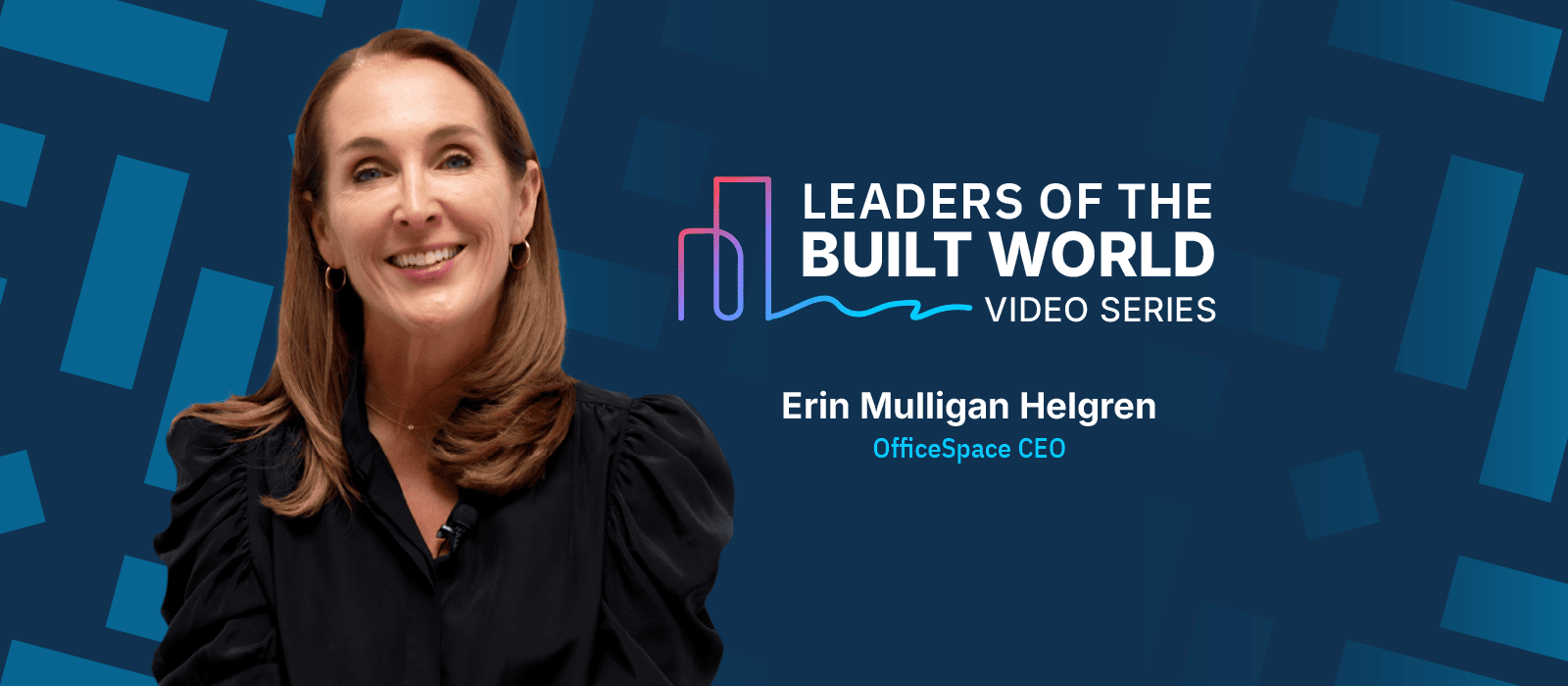
In this episode
• The three metrics every CEO should track for their workplace strategy
• What the built world experience gap is and why it costs organizations trillions
• How collaboration data is redefining what it means to show up to work
• The early and exciting innings of AI in workplace technology
A new era of workplace leadership is here, and OfficeSpace Software is sitting down with the people at the center of the shift. In our new video series, Leaders of the Built World, OfficeSpace CMO Karen Bucks sits down with facilities leaders, space and occupancy planners, and senior executives to explore how the spaces we create influence the way we work, connect, and thrive.
For our debut episode, Karen spoke with Erin Mulligan Helgren, CEO of OfficeSpace Software, for a wide-ranging conversation on the future of work, the role of AI in the workplace, and why the built world experience gap is the defining challenge for enterprise leaders right now.
Meet Erin:
Erin Mulligan Helgren has spent 30-plus years turning complex organizations into growth engines. Before OfficeSpace, she led companies through major transformations at P&G, Dell, PepsiCo, and multiple Vista Equity exits. She’s been named one of the 50 Most Powerful Women in Technology and is a five-time board member. She also played collegiate soccer, which probably explains the relentless drive.
00:30 — 00:37
The built world, defined
Let’s take a step back. What do we mean when we say, “built world”? Erin breaks it down into four categories:
“The built world means to me: the places, the people, the processes, and the assets that make work, work.”
The physical environment shapes everything from productivity to culture, but turning those four elements into a coherent, high-performing workplace takes true strategic leadership and expertise.
00:38 — 1:50
Why workplace leaders are under more pressure than ever
The hybrid era has introduced a kind of ambiguity that workplace leaders have never had to manage before. Who’s coming to work? How often? What kind of space will they need?
Erin describes a wholesale rethinking of the workplace: how spaces are designed, when they’re available, how they’re built out, and who has access to them. Layered on top of that is something that did not exist 10 to 15 years ago: employee experience as a strategic priority.
“If you show up at work and you can’t find a space with the things you need, if you’re not seated by your team, if the people that you need to work with actually didn’t come in that day and you’re Zooming from your physical space, that’s not good for the employee experience.”
Coordinated hybrid schedules and access to spaces and amenities directly impacts how people engage, how productive they are, and whether they feel the commute was worth it.
1:51 — 2:48
The three metrics that matter most for your workplace strategy
Real estate is typically the most expensive line item in a CEO’s P&L. Naturally, the questions leadership is asking are sharp and financial in nature. Erin breaks it down into three layers:
- Cost: Are we getting value out of the space we have? Is it the right space, in the right place, used the right way?
- Utilization: Is our space actually making us more productive and impactful as an organization?
- Employee experience: How are people feeling about where and how they work?
“They’re trying to figure out: do I have the right places in the right spaces with the right people using them at the right time? It’s actually a pretty complex set of questions.”
Aligning all three (cost, utilization, and experience) is the goal of any modern workplace strategy.
2:49 — 4:02
The built world experience gap: The value hiding in plain sight
Erin defines this as the gap between what organizations invest in the workplace and their strategy, and the value realized in return.
You can see it most clearly in occupancy rates. Post-pandemic, average occupancy has fallen significantly across the industry. Walk into most offices midweek and you’ll find half the floor empty, real estate that’s fully leased, fully maintained, and barely used. Meanwhile, employees commute in and can’t access the people, spaces, or tools they need. The impact lands on productivity, engagement, and ultimately retention. Globally, enterprises lose an estimated $1 trillion or more each year to workplace costs, asset failure, and related employee turnover, most of it invisible on a balance sheet.
“Filling that gap solves not only this idea of maximizing utilization, but also maximizing experience and impact. And ultimately, that’s what we want every single employee to feel: it’s worth the commute. I came, I was more productive than I would have been at home, and I’m really happy to be here.”
4:03 — 4:48
The new workplace metrics: Collaboration and high-quality presence
Most organizations are still measuring occupancy: headcounts, badge swipes, desks booked. But is knowing who showed up to the office enough?
“If I come into the office and you actually see that I’m meeting with people and I’m having impromptu conversations and I’m spending time face to face, that is high-quality presence. Versus, if I show up in the office and I’m actually in my cubicle zooming with all the people that aren’t there, that is low-quality presence.”
Collaboration data, not just occupancy data, is where workplace strategy is heading. What matters is the quality of time spent in the office, the interactions it sparks, and whether work is actually moving forward.
4:49 — 5:53
Why unified workplace software wins
For years, the industry has treated IWMS (integrated workplace management systems) and WEX (workplace experience platforms) as separate software categories.
Erin makes the case that separating the building from the people inside it is a fundamentally flawed approach to workplace strategy. When you’re making real decisions about space, you have to think about places, processes, people, and assets together.
“I can’t imagine a world where you can separate out the building and the place from the people who are inside of it.”
5:54 — 7:28
When AI changes how work works
Agentic AI only became a mainstream conversation in 2024, and it’s already permeating nearly every industry. For workplace leaders and space planners, the key to successful agentic programs hinges on a solid data foundation and the right use cases.
Space planning, for example, is one of the most time-intensive functions in workplace management, typically taking months of analysis, scenario modeling, and iteration. When space planners aren’t buried in the mechanics of the work, they can focus on the decisions that actually move the needle: designing spaces that support employee growth, and anticipating what the organization will need to scale.
“Over the next couple of years, we will be looking at a completely reimagined way that space planners do their work and that we’re able to drive impact for all our clients.”
That re-imagination starts with data. Twenty years of anonymized workplace interactions across thousands of enterprise clients gives OfficeSpace a training foundation that can’t be replicated by wrapping a product around a generic large language model. The models are purpose-built, the data is proprietary, and the impact is grounded in how real workplaces actually behave.
Leaders of the Built World is a new series from OfficeSpace Software. Hosted by CMO Karen Bucks, each episode features a conversation with the workplace leaders shaping the future of work. Share your story.

Get exclusive insights on workplace trends
Continue reading
Room scheduling software: The checklist facility teams actually need

What working parents need from employers, according to working parents